from reality to performance and back.

Friday, November 13, 2009

classes

Animals, People and Those In Between

H79.2746.1 Tues 3:30pm to 6:00pm Marina Zurkow
This class uses animals, humans, and other creatures as a way to think about character representation. Claude Levi-Strauss’ observation that “Animals are Good to Think” is the starting point from which we make, discuss, and examine the ways in which art works imagine the interrelationships between the human, the animal, and our environment. If we can only perceive these things through mediation (media representations), then how we represent them is the fundamental question, reflecting our ideologies, prejudices, hopes, and fears. Do we speak for animals, and if so what are we saying for them? Are they friends, pets, environmental equals or beasts? How are hybrid monsters (chimera) created and what do they mean? How do we understand our places as subjects in a landscape or a datascape? How can anthropomorphic cuteness be subversive? This class focuses on questions of intention, relation, and subjectivity, through critical engagement with representations of people, animals, monsters, and mutants, in their respective environments. The class is further focused on the use of character in context, via toy design, robotics, animation, video, image generation or data visualization. There are introductory texts on character development, and generally an emphasis on literary, philosophical and natural history texts, including Jorge Luis Borges, John Berger, Giorgio Agamben, Donna Haraway, Rebecca Solnit, Steve Baker, Deleuze & Guattari. Assignments include studio work and readings. There is more emphasis on the development and analysis of ideas, and less emphasis on particular media or forms. Students make several short projects, backed up by readings and research into precedent art works. There is a final project. Class is a combination of studio critique, responses to art works, reading and discussion. Syllabus

Design Expo

H79.2274.1 Tues 3:30pm to 6:00pm Nancy Hechinger
Students address a design challenge that is presented at the start of the term. Over the course of the semester, students work in small teams to prototype and develop ideas in response to the challenge; classes take the form of critique sessions of these ideas and their presentation. This year's theme is still being finalized and it is likely that several other universities from various countries will also be participating in the Microsoft Design Expo. It is planned that one of the project teams from each university will be invited to present their work to the research and design groups at Microsoft in Redmond, WA over the summer. Syllabus

Design Frontiers in Biology and Materiality

H79.2816.1 Mon 2:30pm to 5:25pm Amanda Parkes
Biological organisms and systems are essentially living machines. Digital technologies allow us to create a control structure with computational predictability and precision. What happens, however, when designers begin to incorporate the self-determined internal control structure of a biological system as part of a design strategy? This course offers a new approach to materiality, positing that all matter is dynamic but exists within a continuum of control ranging from passively temporal (wood, water) to electronically active (photovoltaics, thermochromics) to biologically alive (plants, tissue). This course presents alternative design strategies for creating computational interfacing with living matter and state change of natural materials. Students are introduced to the world of the bio lab from a designer’s perspective, both conceptually and practically. We examine the state-of-the-art in artistic experimentation with biological systems such as the genetic manipulation projects of Eduardo Kac, or the carbon nanotubes grown into architectural structures of Ryan Wartena. We also examine more DIY approaches to living systems integration and interactivity with biological systems. Students use a hands-on approach in their design process, with biological sensing as input and indicators or material state change as an alternative method of information display, for example. This course is designed to further our computational relationship with the natural world pushing forward ideas in sustainability, interactivity, energy production and the emerging relationship between the designer/artist and the bio lab, approaching biology as an open frontier for digital design.

Hospitable Room: Designing a Hospital Pediatric Recreation Room

H79.2820.1 Tues 12:30pm to 3:00pm Marianne Petit / Daniel O'Sullivan
Children in rehabilitation treatment often stay in the hospital for months at a time. We have the opportunity to create a room that will make that stay more fun and entertaining for them. This course will work in collaboration with the NYU Langone Medical Center: The Rusk Institute of Rehabilitation Medicine Pediatric Department. We have outfitted the pediatric recreation room with a video tracking, projection and transmission system through which ITP students participating in this class will build projects that examine how these environmental technologies can improve one's quality of stay in hospital. The technical exercises in the class will be around lighting, camera and coding tricks for video tracking and augmented reality as well as audio and video transmission over IP. Physical computing techniques will also be supported as projects require them. In addition, the class will cover issues of designing for the range of physical and cognitive function of children who will use this space. How can this system be used therapeutically? recreationally? how can it be used to decrease isolation? or foster collaboration? keep them smiling? Students in this class will meet with recreational and occupational therapists, the hospital's Therapeutic Recreation, Child Life & Creative Arts Therapies Department, as well as patients, to determine needs and usage. Final projects to deploy into the facility will be selected by faculty and hospital staff.

Methods of Motion

H79.2448.1 Thur 12:30pm to 3:00pm Marianne Petit
This class explores methods of storytelling through animation. We examine a range of techniques including pixillation, stop motion, collage, abstract and cartoon animation. We apply a variety of tools such as iStopMotion, After Effects, and Flash. There are five animation short animation assignments and one final project. Students are encouraged to experiment. Drawing skills are not necessary though students are required to maintain a weekly sketchbook. A basic knowledge of digital video is a plus. Syllabus

The Softness of Things: Technology in Space and Form

H79.2578.1 Thur 3:30pm to 6:00pm Despina Papadopoulos
Jasper Johns once wrote in his notebook: "Take an object. Do something to it. Do something else to it." In this class we investigate what it means to "do things" to objects in ways that transforms them and our relationship to them. We experiment with materials and objects, stretching their limits and exploring their relationship to space and the body. These investigations are grounded in an understanding of the interactional possibilities of gestures, social and spatial dynamics, networks and open source systems while we develop a new set of artifacts and construction techniques. Softness, modularity, adaptability and re-configurability, washability, power management, connectors and ways to engage the senses (and sensors) are just some of the ideas and topics we examine through weekly assignments and social experiments. Syllabus

Time

H79.2826.1 Wed 6:30pm to 9:00pm Che-Wei Wang
The ways we keep time are the ways we are kept. One might argue that humans ideated timekeeping and now we take it for granted. Without clocks we can't enjoy the benefits of social synchronicity. But with them, we are unwillingly constrained to arbitrary increments that guide our countless decisions. This class uses technology as a way to rethink and recapture the ways we keep time. Over the first half of the semester, we prototype a series of time keeping devices around a set of themes. Blindness, bio-mechanics, materials, space+location, isolation, synchronicity, and collaborative time. Each class begins with the delivery of tools to help construct various types of timepieces along with reviews and discussions. Video, software, motors + mechanisms, electronic signaling and communication tools are covered each week in relation to how they can be used to re-imagine time-keeping. Classes later in the semester are tailored to provide technical and conceptual support for final projects.

When Strangers Meet

H79.2762.1 Tues 3:30pm to 6:00pm Kio Stark
Even the simplest exchange among strangers can contain a tangled accumulation of meanings: what transpires may have physical, emotional, social, political, technological and historical dimensions. This class takes an analytical approach to unraveling and understanding these charged moments. In the process of the studying how and why strangers interact in public, we address some of the abiding themes at ITP—urban behavior, spontaneous interaction, the pleasure of the unexpected, how technology can mediate and/or enable human experience—and we make a close and thorough examination of how they play out in this narrow slice of human experience. This approach is designed to bring students to a more concrete understanding of these larger abstract ideas. Classwork consists of readings, class discussions, field assignments (a series of assigned interactions with strangers that the students will document and discuss) and an analytical final paper. Students learn how the interactions of strangers have changed historically (and why), what the experience of interaction with strangers means to the participants, how strangers 'read' each other, how they initiate interactions, how they avoid interactions, how they trust each other and how they fool each other. Readings range from seminal works on urban sociology and public behavior (Georg Simmel, Stanley Milgram, Erving Goffman, Jane Jacobs, William H. Whyte, Elijah Anderson) to more lyrical examinations of strangers in cities (Tim Etchells, Italo Calvino, Roland Barthes, Walter Benjamin, Edgar Allan Poe) to recent neuropsychiatric discoveries about trust, mimicry, and flash judgments. Because stranger interactions are at heart a means to interrupt the expected narrative of the everyday, we consider the works of artists and thinkers who show how such disruption, surprise, spontaneity, and play are fundamental to the pleasure and substance of urban life, for example: the Situationists and their descendents, Sophie Calle, Marina Abramovic, Francis Alys, Graffiti Research Lab, Robert Rauschenberg, Survival Research Labs. We also explore recent art/technology projects that specifically engage strangers, such as Familiar Strangers, the Listening Station, PostSecret, Oddible, Loca: Set to Discoverable, Following/the Man in the Crowd, Mobile Feelings, and others. Syllabus

Tuesday, October 27, 2009

update after conversation with natalie

>>>>>>>>>>>>>>Update after discussion with Natalie

Site of death (cemetery) as site of ecological renewal

Death routines Natalie Mentioned:

- Turning Carbon remains into diamonds – http://www.lifegem.com/secondary/whatisLG2006.aspx
- Making human DNA trees http://www.trembl.org/alumni/01-03/transplant.html
- In Australia the tradition to plant a tree every year on your birthday – so when you die you leave a forest – forest as your death bed.
- In Halmstad, Sweden they get their thermal heat from the local crematorium http://www.cfosnafu.com/crematorium-towns-new-source-of-heat/

These serve as a contrast to the cemetery safari. They are about somehow “capturing” the dead person and remembering the dead by having something of them forever. Well the diamond idea is just pretty gross. The tree…no matter that the tree is alive, really. It’s a more poetic version of the diamond. It serves the dead person’s memory by existing, not growing. The human’s DNA inside it serves no purpose at all (the genes are not expressed) and in fact may be detrimental, I don’t think anybody knows this for sure yet.

The cemetery safari proposes a memory to death by enabling life. It’s not about capture, but about regeneration.

1. Attending to the dead by attending to nature. As Natalie said, “ritualized process to attend to natural processes.” In a way, its kind of a buddhist idea, I guess. Except the ritual part will be Judeo-Christian style, with lots of ritual and trinkets and songs. [[Nina Katchadourian's song about the organisms that feed off the dead body http://www.ninakatchadourian.com/]].
2. Also thinking about the death part, the ultimate natural process, the one part of our [human, natural] lives in many ways that technology can not save us from…only in birth and death are we still animals…except not even in birth anymore, with all the reproductive technology…so only in death.
3. Death takes up a huge space in the natural system, and a huge part in our cognitive space. Attending to both the cognitive system and the natural system becomes on ritual, one process. Reconciling, in a way, the intellectual and the visceral, the body and the mind, nature and technology. Dead must share space with the living.

Possible Actions:
1. “Pro Life” Personal training routine at the cemetery. Morning jogs at the cemetery allow for an environmental monitoring that is good for my health, too. Do yoga in the morning on the subway up there with Carolyn Wallon?
2. After-dinner nighttime cemetery safari walk. “Go into the underworld: an exploration of the insect world of the cemetery.”
3. Feed the animals by bringing flowers or other things to the dead.

TO DO:
1. Investigate more death routines
2. Investigate different cultures and see what they leave for food
3. Read Charity Scribner, Requiem for Communism, Cultural Memory
4. Learn about plot recycling. When can you put bodies on top of each other? When can you recycle grave sites? How long does our cultural memory last? How long does your posthumous career last?
5. Learn about reincarnation, Buddhist take on death and memory.
6. Think about ecology, ritual, health, death, memory and how they fit together

Friday, October 2, 2009

workshop: conceptions of technology

_ connecting with others in public (and private?) space


> what is your favorite way to communicate with your friends & why?
> what is your favorite way to communicate with your family & why?

>if you could send anything you want over the internet, what would you send? (examples: a kiss. a pinch. a spitball)
>if you could receive anything you want over the internet, what would you send? (examples: a kiss. a pinch. a spitball)

> what do you like about having a phone?
> hate
> what do you hate about people + cell phones on street? bus? tube?
> how would you like to connect to your friends? your mom? your grandma?

>


_ robot friends

> would you want a robot to be your friend?
> what would the robot look like?
> what would the robot do?
> what would you do together?
> how would the robot help you?
> how would you help the robot?
> would you take care of the robot or the robot take care of you? tell me more.


_buttons & switches

>if you could turn a light on by doing anything, what would it be? what would it look like? draw it. tell me how it would feel. tell me what you would have to do to make it work. could someone use it wrong?

>>prompts
- would it make someone turn the light on more or less?
- would it make it more fun/annoying/easy/hard to turn on the light?
- what else does it do, other than turn the light on?

Monday, June 15, 2009

other nyu classes

E90.2983 - ENVIRONMENTAL MONITORING
00143675 W08:55am - 12:15pmWS BARN 401 STU3.0 JEREMIJENKO, NA


sociology
G93.3503 - RESEARCH SEMINAR: URBAN ETHNOGRAPHY
001>31202 T12:30pm - 02:00pmWS 295L 4156 SEM4.0 KLINENBERG, ERI

itp fall 09

Applications of Interactive Telecommunications Technology

H79.2000.1 Call#71392 Tues 4:00pm to 7:30pm Red Burns
This introductory class is designed to allow students to engage in a critical dialogue with leaders drawn from the artistic, non-profit and commercial sectors of the new media field, and to learn the value of collaborative projects by undertaking group presentations in response to issues raised by the guest speakers. Interactive media projects and approaches to the design of new media applications are presented weekly; students are thus exposed to both commercial as well as mission-driven applications by the actual designers and creators of these innovative and experimental projects. By way of this process, all first year students, for the first and only time in their ITP experience, are together in one room at one time, and as a community, encounter, and respond to, the challenges posed by the invited guests. The course at once provides an overview of current developments in this emerging field, and asks students to consider many questions about the state of the art. For example, with the new technologies and applications making their way into almost every phase of the economy and rooting themselves in our day to day lives, what can we learn from both the failures and successes? What are the impacts on our society? What is ubiquitous computing, embedded computing, physical computing? How is cyberspace merging with physical space? Class participation, group presentations, and a final paper are required.

Introduction to Physical Computing

H79.2301.3 Call#71429 Wed 09:30am to 12:00pm Thomas Igoe
H79.2301.4 Call#71430 Wed 3:30pm to 6:00pm Thomas Igoe
H79.2301.2 Call#71428 Wed 12:30pm to 3:00pm Daniel O'Sullivan
H79.2301.1 Call#71427 Tues 12:30pm to 3:00pm Daniel O'Sullivan
H79.2301.5 Call#71431 Thur 12:30pm to 3:00pm Staff
H79.2301.6 Call#71432 Wed 6:30pm to 9:00pm Rory Nugent
This course expands the students' palette for physical interaction design with computational media. We look away from the limitations of the mouse, keyboard and monitor interface of today's computers, and start instead with the expressive capabilities of the human body. We consider uses of the computer for more than just information retrieval and processing, and at locations other than the home or the office. The platform for the class is a microcontroller, a single-chip computer that can fit in your hand. The core technical concepts include digital, analog and serial input and output. Core interaction design concepts include user observation, affordances, and converting physical action into digital information. Students have weekly lab exercises to build skills with the microcontroller and related tools, and longer assignments in which they apply the principles from weekly labs in creative applications. Both individual work and group work is required. Syllabus

Every Bit You Make

H79.2530.1 Call#76839 Mon 12:30pm to 3:00pm Raffi Krikorian
Popular culture and current events have focused the public's attention on surveillance. In the movie adaptation of "Minority Report", the protagonist attempts to hide himself around Washington, DC while technology tracks his every move. That future, maybe, is not that far off-the city of London itself has half a million cameras installed for use by the security services. How can one remain in control of one's identity in that future? This class creates a framework to help students not only analyse existing technology, but also to them think more deeply about their own projects. We review current technologies such as Internet protocols, cellular networks, and RFID; we also get hands-on experience in both using these technologies and hacking them. We all understand why you shouldn't throw out a credit card receipt with the card's number on it without tearing it up, but should we be concerned with clicking on a link on a web page? Or sending an instant message? Or opening a laptop to sign onto the wirless network at Starbucks? Maybe. Clicking on a web page records your IP address on a web server somewhere, instant messages are usually sent off unencrypted over the network, and opening a laptop usually requires negotiation with a DHCP server that records your computer's unique identifier. Our devices and our online interactions leaves a mark as unique as our fingerprints; thus, relevant questions are: how can we turn those tables? What technologies can we create to trace information left by others? Given that openness is a core feature of the networks and technologies we use-what code, regulations, and etiquette make these useable? Weekly classes and assignments are balanced between background survey reading, technical reading, and hands on experience all culminating in a final project.

Future of the Infrastructure

H79.2297.1 Call#76838 Thur 09:30am to 12:00pm Art Kleiner
Can the future be foretold? No, but the long-term outcomes of present-day actions can be foreseen -- and, as the 2008 economic crisis showed us, lack of foresight can have grave implications. Using a technique called scenario planning, students consider the present and future ramifications of knotty, large-scale problems related to the evolution of the internet and other aspects of the telecommunications infrastructure. In exploring this, we touch upon the global economy, demographics, international politics, environmental concerns, and other large-scale issues. Scenario planning is a rigorous but highly engaging technique, in which people share information and judgment to create a picture of the future larger than any individual could produce alone. The technique has been used since the mid-1950s decades to distinguish certainties from uncertainties, and to learn to be prepared for multiple eventualities. Students will conduct original research on significant trends, use those trends to develop compelling, plausible stories about possible futures, and present the futures - and the strategies they suggest - to a public audience. As part of the process that we co-develop, the class explores theories about system dynamics, organizational and societal change, the causes of economic failure and success, and the nature of technology.

Materials and Building Strategies

H79.2025.1 Call#71405 Tues 6:30pm to 9:00pm Peter Menderson
You’ve built a foam prototype. Your project idea is now out in the open sitting on a table where you and your teammates can look at it. It’s not quite what you thought it would be when you made your first rough sketch, there’s even something a little goofy about it, but then there’s also that interesting curve that you hadn’t envisioned. Your teammates have also noticed some things that you hadn’t thought of. You see where you can reshape the foam to make the prototype both look and work better. You’ve made your first step; you’ve moved your project forward. Removing barriers to creative problem solving and learning the steps for advancing a project are the dual purposes of this course. You’re asked to make things over and over during your time at ITP. This class helps you to break out of 2-d screen and keyboard thinking and take advantage of the discoveries that inevitably occur when you're thinking in 3-d by manipulating materials with your hands, observing the results, and refining successive iterations of your idea. From techniques for prototyping and making small objects to fabrication methods for kiosks, you’ll get hands-on experience with a variety of materials and methods. You have an idea for a wearable device? Mock it up with the sewing machine. You're thinking about a squeezable children’s toy with sensors? Make a mold and cast some sensors inside soft rubber. You want to build an installation? Make a foam core model of the space and get a valuable preview of your project installed. During the course you'll be introduced to building in a variety of materials. You’ll make objects of wood, foam, plastic, metal, clay, plaster, rubber, paper and fabric. You’ll move a project from sketch to prototype to presentation and learn to incorporate the lessons of the process into your final product. By taking notice of the unexpected your original concept will evolve, and amplified by those revelations it will surprise you and delight your audience. Syllabus

Mediated Intimacy: Closeness and Distance

H79.2798.1 Call#76844 Mon 3:30pm to 6:00pm Kio Stark
The experience of intimacy across distances is at least as old as the technology of the letter. Since then, every new technology of connection produces new ways of initiating, enriching and sustaining intimacy. These new developments are often perceived simultaneously as creating distance and bridging distance. Because the invention of technologies of intimacy is a perennial pursuit at ITP, the goal of the class is to enrich students' ability to create meaningful and successful projects related to intimacy. Students gain a studied and nuanced understanding of the idea of intimacy and the physical and emotional experiences associated with it— as well as examining how existing and cutting-edge technologies work to connect intimates across the physical and metaphorical distances they routinely experience in everyday life. The first section of the course is devoted to studying intimacy, bonding, attachment, longing and desire from a variety of perspectives. These will include psychology and psychoanalysis— e.g.: Freud, Erich Fromm, Lacan, Kristeva, John Bowlby on attachment, Jessica Benjamin on bonding, Donald Winnicott on intersubjectivity; recent neuroscience, neurochemistry, and evolutionary biology related to intimacy and bonding; and recent psychological work specifically regarding intimacy and the internet. The second section of the course focuses on current art and technology projects— along with commercial ventures— that explore mediated intimacy across distances (the examples are legion). We scrutinize these projects to understand what they do right and what they do wrong. And we investigate the language and syntax of mediated intimacy, including attempts to incorporate each of (or combinations of) the human senses into devices of connectedness. In seeking to articulate what makes a meaningful mediated experience of intimacy, the course also looks at a group of edge cases— for example, personal performances in public (from web-cam girls to performance art)— that support asymmetrical intimacies. Through this process, we attempt to define a set of possible methods from which to create work. Classwork includes short papers throughout the semester and a final research paper or research-based project proposal.

Site-specific: Augmentation, Affinities, and Frames

H79.2620.1 Call#76840 Tues 3:30pm to 6:00pm Marina Zurkow
Site suggests contexts that are spatial, temporal, narrative, and populated. Site-specific works require a frame for participants, a set of stories and a point of entry. More than art within "the framework" of an art institution, site-specific, interactive and community-based works require rigorous levels of observation, interrogation, and participation. Whether in the physical or the virtual public, frame and context are primary considerations in the work you produce. This class is part studio and part refection, using contemporary art examples and writings that engage and critique the local and the global, invert locale and involve the everyday as well as traditional urban studies of observation. The studio portion of the class will either utilize an existent space in New York, or work towards the development of proposals for a fictional grant for lower Manhattan. Syllabus

Video Sculpture

H79.2722.1 Call#71475 Mon 6:30pm to 9:00pm Gabe Barcia-Colombo
Video is the new marble. In this class we breathe new life into video as a medium for creating engaging interactive physical sculpture. Video is no longer a flat screen based medium. How do we create video sculptures that move, emote and react to our presence? The course takes video off the screen and into the world of three-dimensional space in the form of site-specific and or physical installations. Through a series of weekly experiments and assignments, students work with projection, tiny LCD screens, physical sensors and interactive software to hack video into interactive sculptures in the tradition of Nam Jun Paik, Tony Oursler and Camille Utterback. Class is divided between lectures, guest speakers and critical discussion/presentation of work. Previous knowledge of video production / editing is not required, but a mad scientist-like lust to bring video to life is highly encouraged.

Visual Communication

H79.2724.1 Call#76859 Mon 6:30pm to 9:00pm Katherine Dillon
We see information before we read it - and often we see instead of read. Effective technologists and storytellers embrace the importance of visual design and understand the many tools available to convey and manipulate the user experience. These tools include everything from the layout and packaging of the written word to photo editing, information graphics, illustration, typography, animation, color and spatial modeling. This course provides an overview of the tools available and, through a series of practical exercises, enables students to understand the implications of their use. The goal of the course is to provide students with the practical knowledge and critical skills necessary to effectively consider visual design as an important and inevitable component of their work. The goal of the course is to provide students with the practical knowledge and critical skills necessary to effectively consider visual design as an important and inevitable component of their work. This class is especially recommended as an introductory course for people without training in the visual arts who might waive ICM or Physical Computing. Syllabus

Friday, June 12, 2009

rca briefs

RADIO PROJECT


Radio is a strange mix between the physical and the ether; both an interface and content; an object and information.

Radio is... a thing on your kitchen shelf... music... background noise... electronics... services... radiation... networks... broadcasters... communication... culture... shared experiences...

Design a relationship to 'radio’, it could be in the ether or via the internet. It should not merely be about the radio itself, or just interacting with a radio. The radio as a ‘thing’ is simply the means of accessing radio as an experience. As well as practical needs, also think about more complicated and human ones... emotions, behaviours, desires, obsessions.

You could start by thinking a bit about what radio is... the experience it creates, how it mediates between people, whether it entertains, informs or persuades. You might want to consider what it is as a system (What is a live broadcast? Can you listen to two stations at once?); or as content (What can you listen to? What is radio when we can all broadcast?); or its social implications (What is radio in relation to social networks? How does radio create relationships between people, either in the world or in a home?); or as technology (What is internet radio? Why would a radio connect to the web? Is radio just audio?).

The project is also an opportunity to familiarise yourselves with electronics and to begin to explore how you'd like to engage with it as a medium, skill, information, tool and so on.


BMW INTENSE PROJECT -- NOMADS, MINI-NESS AND INFOSPACES


Cars no longer simply travel across geographic and spatial landscapes, they also traverse information landscapes. The tendency though, is to adapt existing objects like phones, TVs, DVD players, and GPS navigation devices for use in the car without really changing the nature of the experience. What if the car itself became an interface, would this suggest new devices, new uses for the car, or even new relationships between people, cars, and environments?

Think of the driver as a nomad using their Mini to navigate, experience and enjoy the information
landscape... what kind of relationship to it would the Mini provide? How would they access it? What tools would they need? How would it differ throughout the day/night and from person to person? How could they do all this in a very ‘Mini’ way?

The purpose of this project is to imagine new scenarios of use for the Mini in relation to information landscapes. And how the specific character of the mini could be reflected in its interactions with an information landscape and any necessary devices and services.


DESIGNER POLITICS


"On 25 April, about 40 members of a Japanese cult called Pana Wave Laboratory took over a 200-meter (600 ft) stretch of mountain road in Gifu prefecture, some 185 miles (300 km) west Tokyo, covering up crash barriers and roadside trees with huge white cloths. After three days, local officials ordered the caravan of 13 white vehicles to move on, but the cultists -- who dress all in white and wear surgical masks as protection against electromagnetic radiation -- refused, explaining that Yuko (Hiroko) Chino, their 69-year old guru, had terminal cancer after communist guerrillas had attacked her with microwaves. "

In this project we will explore the intersection of material culture (stuff, things, physicality) and ideology (ideas, beliefs, values).

What if the Labour and Conservative parties had their own product lines? How would they differ? What would a Conservative toaster be like, a Labour car, a Liberal Democratic mobile phone? This is not about appearance and style, but the values embedded in products and expressed through their functionality.

CLUB MINIHOMPY


This project is a collaboration with the France Telecom team developing a new system which generates an environment allowing people to create tighter social links. These links could be between close friends, relatives, communities of shared interest (such as hobby groups etc.) and people who met both on the Internet and in real life.

The service will contain many elements already familiar to us from existing applications on both desktop machines & mobiles (such as Blogger Flikr, ichat, IM Cyworld etc.). The system is both a web and (critically) mobile-based service and one of your design challenges is to try and take full advantage of both these elements. The system will allow users to design/customise their own ‘spaces’, provide ‘rooms’ that their existing friends can consult and enrich and a network for them to meet new people through. The system will link tightly into the users real life communities and networks.

What the team are keen for this new system to do is ‘strengthen social links’ and to explore ways that people can personalise the space - presenting their own individual quirks, likes and dislikes and blurring the boundary between their on and off-line personas.

Working with the plans for the technical achievements of the new system as a given, your job is to think very specifically about how a real group of users might use or abuse this type of environment.

Each if you will pick an actual Club or Society from the smorgasbord on offer at our neighbouring institution of Imperial College … be it cavers or the conservative club … your mission is to meet these people and persuade them to reveal to you as much information as you can.
We want you to feel as if you know and care about this group, that you understand not just what they do, where they do it and when, but why they do it. What are their motivations? What do they get out of their club? Why on earth did they join? Who are their family and friends? How do they communicate with other people in the club and how do their circles of associates spin out from this group?

Once you have as much information as you can gain about your chosen group you will have to tell us about them – why would we want to join this group?

Only then will you start to design with/for/against them … your design process for this project should be as specific and focussed as you can possibly make it. Focus on your particular club - revel in their specific likes, dislikes, passions and eccentricities and design a way for them to utilise an entirely bespoke system.


NANOTOPIA -- UTOPIA OR DYSPTOPIA?


This project is an opportunity to familiarise yourselves with some of the key issues surrounding
nanoscience and nanotechnology, especially its potential social, cultural and ethical impact on
society.

After some initial familiarisation and research you should identify either a hope or fear for
nanotechnology and develop it into a ‘what if...?’ scenario. Treat it as though it has already happened, and bring back some compelling evidence from your scenario (artefacts from the future) to present in the final crit.

The project has two other important elements: separating fact from fiction in relation to future time
scales; and identifying, making contact with, and consulting experts to help accurately locate your scenario in the near, mid or far future.

ME, ONLY BETTER


From smart pills to designer babies and extended life spans, technology now promises to transform our very nature ...

“We all share a desire for self-improvement. Whether through education, work, parenthood or adhering to religious or ethical codes, each of us seeks to become a ‘better human’ in a variety of ways. And for some people, more consumerist pursuits hold the key to self-improvement: working out in the gym, wearing makeup, buying new clothes, or indulging in a spot of cosmetic surgery.
But now a new set of possibilities is opening up. Advances in biotechnology, neuroscience, computing and nanotechnology mean that we are in the early stages of a period of huge technological potential. Within the next 30 years, it may become commonplace to alter the genetic make-up of our children, to insert artificial implants into our bodies, or to radically extend our life
expectancy.” Paul Miller and James Wilsdon, Demos

This project uses design as a medium to explore the social, cultural and ethical consequences of these developments. Your design proposals should pose questions rather than provide answers, making complex issues tangible, and therefore debatable


MUTATIONS


Media and communication were on a collision course for several years and the fallout has had far-reaching results. Phone companies, Internet providers, and Media conglomerates are converging as the content they deliver and the devices that deliver it are becoming completely interwoven into each other and our technology-driven lives. From a user standpoint though, this has resulted mostly in a culture of the `MULTI` as technologies are simply added on to one another to deliver new types of content to as broad a consumer as possible.
In this project DI and IDE will be working with O2 to rethink the relationship between users, content, devices, and service providers. You will be investigating how these overlapping services, technologies, and objects do not just generate multiple possibilities; they interact with each other and our selves to create mutated ones.

Working in groups of 3 students will research and develop new mutations of communication/media/technology of the near future from the perspective of specific users. The notion of the `user` has changed dramatically and what was once a passive role is now a powerful position which allows people to take an active role in both content production and distribution. Each team must begin by examining a specific group of people to uncover their specific quirks, needs, types of communication, and interactions. From the research you will then develop highly specific services/products/media/devices which address the needs of your group.

In the final stage you will examine broader implications of your group’s specific needs and develop a proposal for how your mutation could affect a broader group of users. Each team will produce a “proof of concept” which explains both their mutation/device through physical prototypes and scenario driven illustrations/films.


54p7


Over the coming years, robots are destined to play a significant role in our daily lives. But how will we interact with them? What kind of new interdependencies and relationships might emerge in relation to different levels of robot intelligence and capability? Given a choice, what would we like to happen? How would we like our robots to exist in our homes, public spaces, cities, countryside, and within our bodies?

There are a number of established areas of research: Creating human or animal-like robots (androids); Robots for doing specific tasks that are too dangerous or unpleasant for humans (industrial, military); Invisible robots (in cars, in cities, automating everyday actions and assisting us); Alternative sources of energy like microbial fuel cells (ecobots, gastrobots, etc); Smart products (eg: robot vacuum cleaners); Networked and cellular robots (eg: swarms of
miniaturised robots); And research into the practicalities and metaphysics of artificial intelligence. But one area that has seen little attention is the design of our interactions with them.
In this project, we would like you to explore the idea of the ‘robot’ from an interaction point of view.

Stay away from the clichĂ©s. Think about meaning, emotional ties, and aesthetics. You can zoom in and focus on details, or zoom out and think about scenarios, it’s up to you, but whatever you do, your design proposal should explore and question social, psychological, political or aesthetic meanings robots might take on in the near future. Some things to think about: What exactly is a ‘robot’? Are artificial life forms robots? When does an animal become a robot / When does a robot become an animal? When does a machine become a robot / When does a robot become a machine

Tuesday, May 12, 2009

jack schulze

http://www.kickerstudio.com/blog/2009/05/six-questions-from-kicker-jack-schulze/

Six Questions from Kicker: Jack Schulze

For the fourth installment in our Six Questions series, Kicker interviews Jack Schulze, of Schulze & Webb.

Jack Schulze

photo courtesy Timo / elasticspace.com

Jack obtained his MA in Interaction Design from the Royal College of Art in 2006, previously running an independent design studio for four years and graduating in Graphic Design from Central Saint Martins in 2000. He is interested in optical perception, especially in display, and focuses his graphics work on looking and perspective. His projects in this area explore maps and representations of urban space. Most recently Jack’s interests are in the aesthetics of mechanisms, and his work is drawn from comics, cinema, manufacture and television.


1. What is the most cherished product in your life? Why?

I have old stuff which is rare and personal, like my grandfather’s migration documents, but those aren’t products. Matt Webb recently pointed me towards Bruce Sterling’s last post on Veridian. Sterling says the only stuff worth keeping is beautiful, emotionally important, or things you use all the time. Sell everything else. I don’t really cherish products that much. They lose their mystery when you work with them every day.

I like Monster Burp most as a product in the world at the moment, and also the Peecol series of figures by Eboy. That world of art vinyl works between manufacture and graphic design. It’s very clever, very elegant. I’m drawing an enormous amount from these bodies of work right now.

There’s also one of my vintage Transformers I really like. Those toys were truly remarkable pieces of engineering and design, and amazingly manufactured too. It is hugely inspirational to imagine there was once this team of people able to conceive, design and manufacture something of that level of beauty and cultural imagination. Amazing that Hasbro have managed to shit on the franchise so badly now.


2. What’s the one product you wish you’d designed, and why?

There are products I wish I’d designed because I like them and then people would think I’d done them and like me more. This list is massive. Off the top of my head: I wish I’d directed and conceived the perfume commercial where a guy on a helicopter kisses a woman at the top of the Eiffel Tower, and a Channel commercial with Little Red Riding Hood shooshing the wolf. I’d like to have been the first to take the photomontages Hockney produced in the 60s. I wish I’d written The Filth by Grant Morrison. I wish I’d conceived and made Super Mario Galaxy. I love the table-top skirmish game called Necromunda in the Warhammer universe, although I only played it once, because the social negotiation of the rules that always happens around the game, are embedded back into the rules. I think Formula 1 television coverage is visually completely remarkable. I have no idea what is going on, but it’s so good I can watch it just for the optics. It’s like injecting Photoshop filters straight into your eyeballs.

There are also those products I wish I’d designed because that would imply I had a much higher level of technical aptitude than I do. But I’m more interested in telling you all the things that would have been better had I done them. This response is more revealing than it looks. Design (verb) is often blamed or cited as to why a product is unsatisfying. Design (noun) is where that process manifests, but it’s rarely the process which has failed. It’s almost always something else.

So most of the things I’d like to redesign would include that something else. I would have to wield the enormous corporate power within the structures from which the design and products are inseparable. I wish I could do this with anything Nokia have produced since the 3210i. I wish I could design the Flash video platform. And someone needs to redesign Adobe Creative Suite, and it may-as-well be me, it certainly can’t get much shitter. I’d really like to work somewhere like Bang & Olufsen, I really appreciate the emphasis they place on desirability.


3. What excites you about being a designer? Why do you keep doing it?

It’s a funny question, like those ones you get for university applications, ‘why do you want to study at Theslethwick College of Brilliance?’ And you always end up thinking ‘um, because it’s on my bus route,’ but you actually write ‘because you reputation is unprecedented and I’m hungry for a stimulating and diverse educational environment,’ etc.

The truth is I don’t do much design. Recently I’ve been working on graphic work around the Here & There projection. That’s design, it’s true, although it isn’t the point of the project but just the current form of the output. Also recently lots of animation and photography, and that isn’t design. Working with Matt to shape the company is not design work. The word ‘design’ as I was taught it has shifted so much that I try to ignore it now. But I have to say, I’m probably unemployable, not having been an employee for ten years and I’ve only got hippy degrees.

I keep doing it because I get excited about my company and working with my colleagues. I like it that the company is set up in a way that there is a balance between working with other companies with very specific, directed interested, and our own explorations. I love working with Matt Webb and a guy called Paul. I like it when I’ve been involved with something that other people like, and I like that the work is culturally interesting and affecting and technically weird and challenges.

I’m personally most excited when I’m involved with something I’m literate in, but technically unfamiliar, when I’m in pursuit of something culturally new or playful. When there’s a sense of discovery or itchyness about newness, that’s when I’m happiest.


4. When do you first remember thinking of yourself as a designer?

Design is a weird word isn’t it? Sometimes it means a job title, hotly contested (not by me). This used to work better when design fields were associated with vocations (book designer, furniture designer). Now it seems suspiciously vague. Design is sometimes used like a verb, like an ambiguous cluster of unfamiliar processes. People say ‘I’m doing some design,’ or ‘I’m designing something.’

I was producing designs and doing design from a very early ago. It was always a component of my drawing as a child. I didn’t start calling myself a designer until I was in my early 20s, but now I don’t find it important to define myself in that territory. It’s easier to describe my company and the projects it has done, or to talk about the people I work with.


5. What’s the most important lesson you’ve learned, and who taught it to you?

No one cares about what you think, unless you do what you think. No one cares what you do, unless you think about what you do. No one ever really cares what you say.

I learnt this lesson from Spencer Thursfield, an old tutor of mine.

Here’s another. You get the work you do. If you want to do something else start doing it.


6. What are the 5 things all designers should know?

1) Don’t use processes like User Centred Design or Usability dogmatically. Learn your trade and do it properly and you’ll be able to deliver work confidently.

2) Talking about your work does not directly improve the actual quality of your work. Ultimately design happens in the world and in your hands, and not in your mouth.

3) Once it was possible for designers to hide in their vocations and ignore the context around their work. Designers are better now because they include business, processes, media and software in the substrates they work with.

4) Some people (they are wrong) say design is about solving problems. Obviously designers do solve problems, but then so do dentists. Design is about cultural invention. There are some people who want to reduce the domain of design to listable, knowable stuff, so it’s easy to talk about. Design is a glamorous, glittering world and this means they can engage without having to actually risk themselves on the outcome of their work. This is damaging. It turns design into something terrified of invention. Design is about risk. We all fear authentic public response to our work, but we have to be brave enough to overcome.

5) Always have nice pens.

Post a Comment

Your email is never published nor shared. Required fields are marked *
*
*

Saturday, May 9, 2009

crisis meets crisis

from

Pompeii on the American Riviera

jesusita.jpg


One firefighter called the blaze a “three-headed monster”: it’s moving in three directions at once, and given the wind, its movement is unpredictable. As of yesterday, seventy-five homes were destroyed and thousands more were in danger. No deaths have been reported, though eleven firefighters have been injured. In spite of all this, Satya reports that “spirits are high. I think the whole town is just in awe of what could’ve been, if the emergency crews—all those involved, from city officials to police to firefighters—had not been as prepared and outfitted with resources as they have been.” Such preparedness is the slightly charred silver lining left behind by Santa Barbara’s last major fire, which was extinguished just six months ago.

It remains to be seen what will become of all those dismal cruise vacations, lately rerouted from Mexico through the “American Riviera” (i.e. Santa Barbara) due to swine-flu concerns. Crisis meets crisis.

Friday, May 8, 2009

the illumination of perspective

photos from jason hawke via http://www.boston.com/bigpicture/2009/04/human_landscapes_from_above.html

the things we use, buy

Red vans awaiting shipment, parked on disused aerodrome at Upper Heyford Oxfordshire, UK. [google map] (© Jason Hawkes)

where we sleep, eat, live

Apartment blocks, Hong Kong mainland. China. (© Jason Hawkes) #

how we grow

Lines of crops growing near the Village of Prickwillow in Cambridgeshire. [google map] (© Jason Hawkes) #

how we enjoy nature

Footpaths criss-crossing Hyde Park in London, UK. [google map] (© Jason Hawkes) #

how we destroy nature

Mucking Marshes Landfill, a major landfill site servicing London. [google map] (© Jason Hawkes) #

how we sleep, eat, live (the american dream)

Newly built housing and new housing plots on edge of Las Vegas, Nevada, USA. [google map] (© Jason Hawkes) #


bio terrorist survivor


In this April 28, 2009 photo, Edgar Hernandez, 4, who according to Mexico's Veracruz state authorities survived the swine flu, plays in his garden in La Gloria, Mexico. Hundreds of his neighbors in La Gloria - villagers who live among pig-breeding farms - were suffering from flu-like symptoms, as well. (AP Photo/Alexandre Meneghini) #

gaurding the bio terrorists


An Egyptian policeman wears a mask as he stands guard in front of a pick up truck full of pigs at the main slaughterhouse in Cairo April 30, 2009. Egypt, hit hard by bird flu, has ordered the slaughter of every pig herd in the country as a precaution against swine flu, a step the United Nations said was a mistake. (REUTERS/Asmaa Waguih) #

tomorrow's future is today's present


A couple wearing surgical masks to avoid influenza A (H1N1) (swine flu virus), kisses at Mexico City's Zocalo square, on April 30, 2009. (LUIS ACOSTA/AFP/Getty Images) #

touching @ mit


sos_comp_4551

The “SOS - Stress outsourced” project taps into the idea of combining crowd sourcing concepts and social networking with physical stimulation. In this case, a jacket equipped with a set of actuators emits massage strokes, when people send a signal via some social network. Buttons that allow to call for a massage or send a stroke to others are also embedded into the jacket. What charmed me most about this project is that it claims to be built on the old Korean saying of “ten spoons of rice make a meal”. So ten (otherwise really useless) “pokes” in Facebook can make a nice massage!

http://project-sos.mit.edu/index.html

from http://www.susannahertrich.com/notes/


research rant

towards a research that engages the public (participatory research or whatever you want to call it) and somehow can make sense of the irrational. if the goal of the research is a solution (a better service, a better product, a better way for a company/government/institution to engage with the people it serves, then surely the research process must truly include suggestions coming from the subject (which is so hard when you only ask them questions, they are only responding and not really creating, brainstorming). asking people to prototype, to play with whatever thing is supposed to be "beyond them" (be it new technologies of medical care or whatever) within their own understandings and how they will use it and how it will make sense in their lives, that is a true engagement. just give them the tools and see what they do, instead of endlessly questioning them on what you've built.

and the research presentation must in some way be able to capture not only their ideas but also the context of their ideas, experiences, etc and also just a wee bit of the irrational that is so crucial to their experiences etc. if our points to the problems of when irrationality exited the picture, how come research papers make usually no room for irrationality? how to present irrationality in a way that better portrays what happened and what is felt? writing can be hard, although Turkle's Inner History of Devices is going there by combining memoir, psychologist and ethnographer all as equals in a bit to understand what is going on with people and their machines. animation is one solution.

so this is all with technology but it doesnt have to be. instead of asking 4-year olds to make their own fly-eating robots in order to arrive at some kind of thought process about how cruel do we build our machines, well how do you involve disabled people to actually participate in the thinking about what services they get? beyond their parents answering questionnaires. as new policy is developed how do you use the research you do to inform some kind of activity public engagement sessions that encourage the people for whom these services are being developed to take part at a rather initial stage in thinking throught the ethical/emotional/but also practical issues of whatever treatment, service, etc is being developed, in the end for them? dunno to me this idea of engaging people in the developement of technology that will effect them by asking them to develop their own things and then learning from that can be applied in so so so many ways and animation as presentation also in so so many ways....to explore their dreams thoughts blah blah that can be floating behind them but that is just as important as what is 'real' and visible....

some inspirations from http://www.we-make-money-not-art.com/archives/2008/11/if-there-are-images-in.php

I was a student of Durrell Bishop, Tony Dunne, Bill Gaver, Fiona Raby, and other fine tutors at what's now the Design Interactions course at the Royal College of Art. In this context, my practice emerged through an interrogation of design methods and aims. Material Beliefs is an attempt to make design's association with science and technology more embedded. It takes influence from Doubleday's - and previously Bruno Latour's and Steve Woolgars - encampment in labs. The difference is that the role of that occupation is more than analytical, it attempts to synthesise outcomes - what happens when speculative attitudes to science and technology get located at the site of laboratory research? Well not much sometimes, but other times it works out and you get a fascinating and messy shared practice. Designers and Scientists/Engineers also have to work harder to understand each others roles and offer respect and support - it's difficult and rewarding.

0aaflyeatij.jpg
Building fly-eating robots at the Royal Institution of Great Britain

The other aspect is that these collaborations take place in public as much as possible. Taking inspiration from Miodownik, Laughlin and Conreen, it's about doing the work in front of and with audiences. These are not only the audiences you might find at art or design exhibitions. Sometimes the model of public engagement is not top-down, but about getting people into labs and enabling them to do new stuff - making enquiries, building their own prototypes, asking researchers about the ethics of technology, finding out how funding is awarded.

Here design becomes a tool for translating academic knowledge into resources for independent enquiry, and a way of enabling others to access technology. This can be tricky as you have to sneak people into labs, under the radar of public relations departments who might not see the value of access for groups that wont promote the research in a straightforward way. This is not a criticism, it just that some institutions are not yet set up for challenging forms of public engagement. This situation I think is aggravated by an institutional anxiety about campaigning groups, but that is another story.

Finally, when I first Googled "Material Beliefs" it was all about religious practices, and it seemed appropriate, seeing as we were going to be doing so much preaching.

0aaneruroscopepr.jpg
Neuroscope Prototype © Elio Caccavale 2008

Material Beliefs looks like a unique structure. I suspect that many artists and designers would dream of engaging with emerging biomedical and cybernetic technology in close cooperation with engineers and social scientists. Which kind of advice would you give to artists or designers who might want to set up a design lab like yours? How did you manage to get the ear (and funding) of the Engineering and Physical Sciences Research Council in England?

It's a good time to extend design practices that ask questions about our relationship with technology and science. In the UK at least, there is an ongoing discussion about how public engagement of science should be done. This is a discussion at a policy level, about democratising access to the research that will have its outcomes in the products and services we use. So while public engagement of science used to be about persuading the public that science produced a benefit, or where it was a strategy for encouraging a new generation of scientists, engineers and mathematicians to keep the nation competitive, it is now also about looking for new ways to involve different groups of people in science. These discussions then filter down into decisions about how funding is awarded. I think Material Beliefs probably benefited from new attitudes about what public engagement of science is allowed to be.

We set out to say that design lets non-specialists respond to science in creative ways, to make their own things out of their curiosities with bioengineering, and to have an active role within the production of research, or at least to play a role in the discussion of what unfinished research might come to mean. Rather than be told that this or that technology is not really risky, or at best being invited into a conversation that decides if a technology is risky, publics can actually have some kind of active role in how technology encountered. That's what design can do, it encourages an active orientation towards materials and processes, it provides a reason to try to do something, rather than sit back passively, then point your finger out of anxiety, for example over the potential effects of biotechnological products and services that suddenly appear on the market - "Where did that come from? Frankenfoods messing up my body, I am even angrier now!". The fact is that science is complex, it is enacted through a relationship between peers and rivals, institutions, markets, funders, politicians, ethics committees. Rather than ignore that, or treat science as monolithic entity, why not try to situate a practice productively somewhere amongst this fascinating network? Material Beliefs is only starting to think about this extended role for design, others have been doing it for some time, and I'm thinking of Natalie Jeremijenko's practice, Symbiotica's lab in Perth, and the thinking that has informed the Design Interactions course.

0aagrouproundhosue.jpg
Group from the Roundhouse interviewing researchers about cyborgs

More generally, how do scientists react to your interests and works? Are they immediately ready to cooperate? Do you have to painfully win them over? How easy is the dialogue with people who seem to have a radically different background?

One thing learnt from this project is to take the invitations very wide initially, and to rapidly make sense of who might want to collaborate. Material Beliefs is lead by the designers, James Auger, Elio Caccavale, Jimmy Loizeau, Susana Soares and myself, and I must say that all of us broke our backs pursuing eminent, exciting but ultimately uninterested scientists and engineers. If people want to do stuff, then run with them. The hardest aspect was articulating our approach, and making it clear what was expected and what we would be doing. Academics are busy, whatever their discipline, and there are not many academics you could expect to spend time doing activities that are outside of there specialism. That is asking a lot.

Luckily, there is some pressure on science and engineering to do public engagement. Being able to show you have done this helps with funding. This was something we could appeal to. I don't think this is being tricksy, it's just a matter of finding a recognisable space in which to hold the stuff you want to do, that makes sense for everyone, even if it is for slightly different reasons. You all need to take risks, the designer needs to be elastic with their focus as a practitioner, and the engineer scientists need to take into account alternative descriptions of their research objects. It's not easy to make sense of a question about the ethics of a technology that you have been developing intensively for two years.

We are, or I hope were, quite naive in the way we approached science, which of course has a different culture to design. I have a particularly painful memory of filming an interview with a researcher, and not making it clear that the interview was to be put online. He was very angry when | sent him a link for approval, particularly as the first clip was me setting up and dropping the camera, and kind of laughing awkwardly. I thought the clip was charming. He thought I was taking the piss, and sent some quite angry emails. Have a look at some of the interviews that did get approved. This was a way for us to read around the research, to get it from the researchers mouths. Their descriptions are imbued with their excitement, and taken down a notch so we can understand. Perfect. Imaging having to orientate your practice to biotechnology through academic papers, or newspapers - the extremes of possible discourses - that leave you respectively bewildered or sour.

0aacarnivolabor.jpg

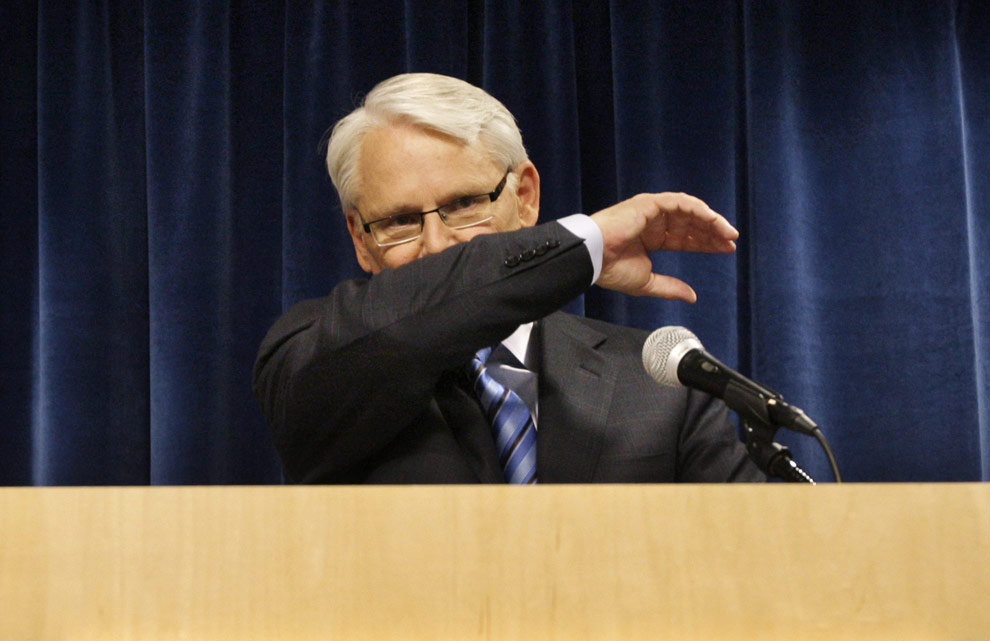
how to cough


British Columbia Premier Gordon Campbell demonstrates how to cover your face while coughing, during a news conference at the BC Centre for Disease Control in Vancouver, British Columbia May 1, 2009. Several more cases of influenza A (H1N1), formerly referred to as swine flu, were confirmed in the province. (REUTERS/Lyle Stafford) #

http://www.boston.com/bigpicture/2009/05/2009_swine_flu_outbreak.html

Wednesday, April 29, 2009

Brain Gain

Brain Gain

The underground world of “neuroenhancing” drugs.

by Margaret Talbot April 27, 2009

Every era has its defining drug. Neuroenhancers are perfectly suited for our efficiency-obsessed, BlackBerry-equipped office culture.

Every era has its defining drug. Neuroenhancers are perfectly suited for our efficiency-obsessed, BlackBerry-equipped office culture.

A young man I’ll call Alex recently graduated from Harvard. As a history major, Alex wrote about a dozen papers a semester. He also ran a student organization, for which he often worked more than forty hours a week; when he wasn’t on the job, he had classes. Weeknights were devoted to all the schoolwork that he couldn’t finish during the day, and weekend nights were spent drinking with friends and going to dance parties. “Trite as it sounds,” he told me, it seemed important to “maybe appreciate my own youth.” Since, in essence, this life was impossible, Alex began taking Adderall to make it possible.

Adderall, a stimulant composed of mixed amphetamine salts, is commonly prescribed for children and adults who have been given a diagnosis of attention-deficit hyperactivity disorder. But in recent years Adderall and Ritalin, another stimulant, have been adopted as cognitive enhancers: drugs that high-functioning, overcommitted people take to become higher-functioning and more overcommitted. (Such use is “off label,” meaning that it does not have the approval of either the drug’s manufacturer or the Food and Drug Administration.) College campuses have become laboratories for experimentation with neuroenhancement, and Alex was an ingenious experimenter. His brother had received a diagnosis of A.D.H.D., and in his freshman year Alex obtained an Adderall prescription for himself by describing to a doctor symptoms that he knew were typical of the disorder. During his college years, Alex took fifteen milligrams of Adderall most evenings, usually after dinner, guaranteeing that he would maintain intense focus while losing “any ability to sleep for approximately eight to ten hours.” In his sophomore year, he persuaded the doctor to add a thirty-milligram “extended release” capsule to his daily regimen.

Alex recalled one week during his junior year when he had four term papers due. Minutes after waking on Monday morning, around seven-thirty, he swallowed some “immediate release” Adderall. The drug, along with a steady stream of caffeine, helped him to concentrate during classes and meetings, but he noticed some odd effects; at a morning tutorial, he explained to me in an e-mail, “I alternated between speaking too quickly and thoroughly on some subjects and feeling awkwardly quiet during other points of the discussion.” Lunch was a blur: “It’s always hard to eat much when on Adderall.” That afternoon, he went to the library, where he spent “too much time researching a paper rather than actually writing it—a problem, I can assure you, that is common to all intellectually curious students on stimulants.” At eight, he attended a two-hour meeting “with a group focussed on student mental-health issues.” Alex then “took an extended-release Adderall” and worked productively on the paper all night. At eight the next morning, he attended a meeting of his organization; he felt like “a zombie,” but “was there to insure that the semester’s work didn’t go to waste.” After that, Alex explained, “I went back to my room to take advantage of my tired body.” He fell asleep until noon, waking “in time to polish my first paper and hand it in.”

I met Alex one evening last summer, at an appealingly scruffy bar in the New England city where he lives. Skinny and bearded, and wearing faded hipster jeans, he looked like the lead singer in an indie band. He was ingratiating and articulate, and smoked cigarettes with an ironic air of defiance. Alex was happy enough to talk about his frequent use of Adderall at Harvard, but he didn’t want to see his name in print; he’s involved with an Internet start-up, and worried that potential investors might disapprove of his habit.

After we had ordered beers, he said, “One of the most impressive features of being a student is how aware you are of a twenty-four-hour work cycle. When you conceive of what you have to do for school, it’s not in terms of nine to five but in terms of what you can physically do in a week while still achieving a variety of goals in a variety of realms—social, romantic, sexual, extracurricular, rĂ©sumĂ©-building, academic commitments.” Alex was eager to dispel the notion that students who took Adderall were “academic automatons who are using it in order to be first in their class, or in order to be an obvious admit to law school or the first accepted at a consulting firm.” In fact, he said, “it’s often people”—mainly guys—“who are looking in some way to compensate for activities that are detrimental to their performance.” He explained, “At Harvard, at least, most people are to some degree realistic about it. . . . I don’t think people who take Adderall are aiming to be the top person in the class. I think they’re aiming to be among the best. Or maybe not even among the best. At the most basic level, they aim to do better than they would have otherwise.” He went on, “Everyone is aware of the fact that if you were up at 3 A.M. writing this paper it isn’t going to be as good as it could have been. The fact that you were partying all weekend, or spent the last week being high, watching ‘Lost’—that’s going to take a toll.”

Alex’s sense of who uses stimulants for so-called “nonmedical” purposes is borne out by two dozen or so scientific studies. In 2005, a team led by Sean Esteban McCabe, a professor at the University of Michigan’s Substance Abuse Research Center, reported that in the previous year 4.1 per cent of American undergraduates had taken prescription stimulants for off-label use; at one school, the figure was twenty-five per cent. Other researchers have found even higher rates: a 2002 study at a small college found that more than thirty-five per cent of the students had used prescription stimulants nonmedically in the previous year.

Drugs such as Adderall can cause nervousness, headaches, sleeplessness, and decreased appetite, among other side effects. An F.D.A. warning on Adderall’s label notes that “amphetamines have a high potential for abuse” and can lead to dependence. (The label also mentions that adults using Adderall have reported serious cardiac problems, though the role of the drug in those cases is unknown.) Yet college students tend to consider Adderall and Ritalin benign, in part because they are likely to know peers who have taken the drugs since childhood for A.D.H.D. Indeed, McCabe reports, most students who use stimulants for cognitive enhancement obtain them from an acquaintance with a prescription. Usually, the pills are given away, but some students sell them.

According to McCabe’s research team, white male undergraduates at highly competitive schools—especially in the Northeast—are the most frequent collegiate users of neuroenhancers. Users are also more likely to belong to a fraternity or a sorority, and to have a G.P.A. of 3.0 or lower. They are ten times as likely to report that they have smoked marijuana in the past year, and twenty times as likely to say that they have used cocaine. In other words, they are decent students at schools where, to be a great student, you have to give up a lot more partying than they’re willing to give up.

The BoredAt Web sites—which allow college students to chat idly while they’re ostensibly studying—are filled with messages about Adderall. Posts like these, from the BoredAtPenn site, are typical: “I have some Adderall—I’m sitting by room 101.10 in a grey shirt and headphones”; “I have Adderall for sale 20mg for $15”; “I took Adderall at 8 p.m., it’s 6:30 a.m. and I’ve barely blinked.” On the Columbia site, a poster with an e-mail address from CUNY complains that her friends take Adderall “like candy,” adding, “I don’t want to be at a disadvantage to everyone else. Is it really that dangerous? Will it fuck me up? My grades weren’t that great this year and I could do with a bump.” A Columbia student responds, “It’s probably not a good idea if you’re not prescribed,” but offers practical advice anyway: “Keep the dose normal and don’t grind them up or snort them.” Occasional dissents (“I think there should be random drug testing at every exam”) are drowned out by testimonials like this one, from the BoredAtHarvard site: “I don’t want to be a pusher or start people on something bad, but Adderall is AMAZING.”

Alex remains enthusiastic about Adderall, but he also has a slightly jaundiced critique of it. “It only works as a cognitive enhancer insofar as you are dedicated to accomplishing the task at hand,” he said. “The number of times I’ve taken Adderall late at night and decided that, rather than starting my paper, hey, I’ll organize my entire music library! I’ve seen people obsessively cleaning their rooms on it.” Alex thought that generally the drug helped him to bear down on his work, but it also tended to produce writing with a characteristic flaw. “Often, I’ve looked back at papers I’ve written on Adderall, and they’re verbose. They’re belaboring a point, trying to create this airtight argument, when if you just got to your point in a more direct manner it would be stronger. But with Adderall I’d produce two pages on something that could be said in a couple of sentences.” Nevertheless, his Adderall-assisted papers usually earned him at least a B. They got the job done. As Alex put it, “Productivity is a good thing.”

Last April, the scientific journal Nature published the results of an informal online poll asking whether readers attempted to sharpen “their focus, concentration, or memory” by taking drugs such as Ritalin and Provigil—a newer kind of stimulant, known generically as modafinil, which was developed to treat narcolepsy. One out of five respondents said that they did. A majority of the fourteen hundred readers who responded said that healthy adults should be permitted to take brain boosters for nonmedical reasons, and sixty-nine per cent said that mild side effects were an acceptable risk. Though a majority said that such drugs should not be made available to children who had no diagnosed medical condition, a third admitted that they would feel pressure to give “smart drugs” to their kids if they learned that other parents were doing so.

Such competitive anxieties are already being felt in the workplace. Recently, an advice column in Wired featured a question from a reader worried about “a rising star at the firm” who was “using unprescribed modafinil to work crazy hours. Our boss has started getting on my case for not being as productive.” And on Internet forums such as ImmInst, whose members share a nerdy passion for tweaking their cognitive function through drugs and supplements, people trade advice about dosages and “stacks”—improvised combinations—of neuroenhancers. (“Cut a tablet into fourths and took 25 mg every four hours, 4 times today, and had a great and productive day—with no side effects.”) In one recent post, a fifty-two-year-old—who was working full time, studying for an advanced degree at night, and “married, etc.”—wrote that after experimenting with modafinil he had settled on two daily doses of a hundred milligrams each. He believed that he was “performing a little better,” adding, “I also feel slightly more animated when in discussion.”

Not long ago, I met with Anjan Chatterjee, a neurologist at the University of Pennsylvania, in his office, which is tucked inside the labyrinthine Penn hospital complex. Chatterjee’s main research interests are in subjects like the neurological basis of spatial understanding, but in the past few years, as he has heard more about students taking cognitive enhancers, he has begun writing about the ethical implications of such behavior. In 2004, he coined the term “cosmetic neurology” to describe the practice of using drugs developed for recognized medical conditions to strengthen ordinary cognition. Chatterjee worries about cosmetic neurology, but he thinks that it will eventually become as acceptable as cosmetic surgery has; in fact, with neuroenhancement it’s harder to argue that it’s frivolous. As he notes in a 2007 paper, “Many sectors of society have winner-take-all conditions in which small advantages produce disproportionate rewards.” At school and at work, the usefulness of being “smarter,” needing less sleep, and learning more quickly are all “abundantly clear.” In the near future, he predicts, some neurologists will refashion themselves as “quality-of-life consultants,” whose role will be “to provide information while abrogating final responsibility for these decisions to patients.” The demand is certainly there: from an aging population that won’t put up with memory loss; from overwrought parents bent on giving their children every possible edge; from anxious employees in an efficiency-obsessed, BlackBerry-equipped office culture, where work never really ends.

Chatterjee told me that many people who come to his clinic are cognitively preoccupied versions of what doctors call the “worried well.” The day I visited his office, he had just seen a middle-aged woman, a successful Philadelphia lawyer, who mentioned having to struggle a bit to come up with certain names. “Here’s an example of someone who by most measures is doing perfectly fine,” Chatterjee said. “She’s not having any trouble at work. But she notices she’s having some problems, and it’s very hard to know how much of that is just getting older.” Of course, people in her position could strive to get regular exercise and plenty of intellectual stimulation, both of which have been shown to help maintain cognitive function. But maybe they’re already doing so and want a bigger mental rev-up, or maybe they want something easier than sweaty workouts and Russian novels: a pill.

Recently, I spoke on the phone with Barbara Sahakian, a clinical neuropsychologist at Cambridge University, and the co-author of a December, 2007, article in Nature, “Professor’s Little Helper.” Sahakian, who also consults for several pharmaceutical companies, and her co-author, Sharon Morein-Zamir, reported that a number of their colleagues were using prescription drugs like Adderall and Provigil. Because the drugs are easy to buy online, they wrote, it would be difficult to stop their spread: “The drive for self-enhancement of cognition is likely to be as strong if not stronger than in the realms of ‘enhancement’ of beauty and sexual function.” (In places like Cambridge, at least.)

When I spoke with Sahakian, she had just flown from England to Scottsdale, Arizona, to attend a conference, and she was tired. She might, justifiably, have forgone distractions like me, but she had her cell phone with her, and though it was a weekend morning some industrious person in the Cambridge news office had reached Sahakian in her hotel room, after she got out of the shower and before she had to rush to the first session. “We may be healthy and high-functioning, and think of ourselves that way, but it’s very rare that we are actually functioning at our optimal level,” Sahakian said. “Take me. I’m over here, and I’ve got jet lag and I’ve got to give a talk tonight and perform well, in what will be the middle of the night, U.K. time.” She mentioned businessmen who have to fly back and forth across the Atlantic: “The difference between making a deal and not is huge and they sometimes only have one meeting to try and do it.” She sympathized with them, but, she added, “we are a society that so wants a quick fix that many people are happy to take drugs.”

For the moment, people looking for that particular quick fix have a limited choice of meds. But, given the amount of money and research hours being spent on developing drugs to treat cognitive decline, Provigil and Adderall are likely to be joined by a bigger pharmacopoeia. Among the drugs in the pipeline are ampakines, which target a type of glutamate receptor in the brain; it is hoped that they may stem the memory loss associated with diseases like Alzheimer’s. But ampakines may also give healthy people a palpable cognitive boost. A 2007 study of sixteen healthy elderly volunteers found that five hundred milligrams of one particular ampakine “unequivocally” improved short-term memory, though it appeared to detract from episodic memory—the recall of past events. Another class of drugs, cholinesterase inhibitors, which are already being used with some success to treat Alzheimer’s patients, have also shown promise as neuroenhancers. In one study, the drug donepezil strengthened the performance of pilots on flight simulators; in another, of thirty healthy young male volunteers, it improved verbal and visual episodic memory. Several pharmaceutical companies are working on drugs that target nicotine receptors in the brain, in the hope that they can replicate the cognitive uptick that smokers get from cigarettes.

Zack and Casey Lynch are a young couple who, in 2005, launched NeuroInsights, a company that advises investors on developments in brain-science technology. (Since then, they’ve also founded a lobbying group, the Neurotechnology Industry Organization.) Casey and Zack met as undergraduates at U.C.L.A.; she went on to get a master’s degree in neuroscience at U.C.S.F., and he became an executive at a software company. Last summer, I had coffee with them in the Noe Valley neighborhood of San Francisco, and they both spoke with casual certainty about the coming market for neuroenhancers. Zack, who has a book being published this summer, called “The Neuro Revolution,” said, “We live in an information society. What’s the next form of human society? The neuro-society.” In coming years, he said, scientists will understand the brain better, and we’ll have improved neuroenhancers that some people will use therapeutically, others because they are “on the borderline of needing them therapeutically,” and others purely “for competitive advantage.”

Zack explained that he didn’t really like the term “enhancement”: “We’re not talking about superhuman intelligence. No one’s saying we’re coming out with a pill that’s going to make you smarter than Einstein! . . . What we’re really talking about is enabling people.” He sketched a bell curve on the back of a napkin. “Almost every drug in development is something that will take someone who’s working at, like, forty per cent or fifty per cent, and take them up to eighty,” he said.

New psychiatric drugs have a way of creating markets for themselves. Disorders often become widely diagnosed after drugs come along that can alter a set of suboptimal behaviors. In this way, Ritalin and Adderall helped make A.D.H.D. a household name, and advertisements for antidepressants have helped define shyness as a malady. If there’s a pill that can clear up the wavering focus of sleep-deprived youth, or mitigate the tip-of-the-tongue experience of middle age, then those rather ordinary states may come to be seen as syndromes. As Casey put it, “The drugs get better, and the markets become bigger.”

“Yes,” Zack said. “We call it the lifestyle-improvement market.”

The Lynches said that Provigil was a classic example of a related phenomenon: mission creep. In 1998, Cephalon, the pharmaceutical company that manufactures it, received government approval to market the drug, but only for “excessive daytime sleepiness” due to narcolepsy; by 2004, Cephalon had obtained permission to expand the labelling, so that it included sleep apnea and “shift-work sleep disorder.” Net sales of Provigil climbed from a hundred and ninety-six million dollars in 2002 to nine hundred and eighty-eight million in 2008.

Cephalon executives have repeatedly said that they do not condone off-label use of Provigil, but in 2002 the company was reprimanded by the F.D.A. for distributing marketing materials that presented the drug as a remedy for tiredness, “decreased activity,” and other supposed ailments. And in 2008 Cephalon paid four hundred and twenty-five million dollars and pleaded guilty to a federal criminal charge relating to its promotion of off-label uses for Provigil and two other drugs. Later this year, Cephalon plans to introduce Nuvigil, a longer-lasting variant of Provigil. Candace Steele, a spokesperson, said, “We’re exploring its possibilities to treat excessive sleepiness associated with schizophrenia, bipolar depression, traumatic injury, and jet lag.” Though she emphasized that Cephalon was not developing Nuvigil as a neuroenhancer, she noted, “As part of the preparation for some of these other diseases, we’re looking to see if there’s improvement in cognition.”

Unlike many hypothetical scenarios that bioethicists worry about—human clones, “designer babies”—cognitive enhancement is already in full swing. Even if today’s smart drugs aren’t as powerful as such drugs may someday be, there are plenty of questions that need to be asked about them. How much do they actually help? Are they potentially harmful or addictive? Then, there’s the question of what we mean by “smarter.” Could enhancing one kind of thinking exact a toll on others? All these questions need proper scientific answers, but for now much of the discussion is taking place furtively, among the increasing number of Americans who are performing daily experiments on their own brains.

Paul Phillips was unusual for a professional poker player. When he joined the circuit, in the late nineties, he was already a millionaire: a twenty-something tech guy who had started off writing software, helped found an Internet portal called go2net, and cashed in at the right moment. He was cerebral and, at times, brusque. His nickname was Dot Com. On the international poker-tournament scene—where the male players tend to be either unabashedly schlumpy or sharply dressed in the manner of a Vegas hotel manager—Phillips cultivated a geeky New Wave style. He wore vintage shirts in wild geometric patterns; his hair was dyed orange or silver one week, shaved off the next. Most unusual of all, Phillips talked freely about taking prescription drugs—Adderall and, especially, Provigil—in order to play better cards.

He first took up the game in 1995, when he was in college, at U.C. San Diego. He recalled, “It was very mathematical, but you could also inject yourself into the game and manipulate the other guy with words”—more so than in a game like chess. Phillips soon felt that he had mastered the strategic aspects of poker. The key variable was execution. At tournaments, he needed to be able to stay focussed for fourteen hours at a stretch, often for several days, but he found it difficult to do so. In 2003, a doctor gave him a diagnosis of A.D.H.D., and he began taking Adderall. Within six months, he had won $1.6 million at poker events—far more than he’d won in the previous four years. Adderall not only helped him concentrate; it also helped him resist the impulse to keep playing losing hands out of boredom. In 2004, Phillips asked his doctor to give him a prescription for Provigil, which he added to his Adderall regimen. He took between two hundred and three hundred milligrams of Provigil a day, which, he felt, helped him settle into an even more serene and objective state of mindfulness; as he put it, he felt “less like a participant than an observer—and a very effective one.” Though Phillips sees neuroenhancers as essentially steroids for the brain, they haven’t yet been banned from poker competitions.

Last summer, I visited Phillips in the high-desert resort town of Bend, Oregon, where he lives with his wife, Kathleen, and their two daughters, Ivy and Ruby. Phillips, who is now thirty-six, seemed a bit out of place in Bend, where people spend a lot of time skiing and river rafting. Among the friendly, faithfully recycling locals, he was making an effort to curb his caustic side. Still, when I first sent Phillips an e-mail asking him to explain, more precisely, how Provigil affected him, he couldn’t resist a smart-ass answer: “More precisely: after a pill is consumed, tiny molecules are absorbed into the bloodstream, where they eventually cross the blood-brain barrier and influence the operation of the wetware up top.”

In person, he was more obliging. He picked me up at the Bend airport driving a black convertible BMW, and we went for coffee at a cheery cafĂ© called Thump. Phillips wore shorts and flip-flops and his black T-shirt displayed an obscure programming joke. “Poker is about sitting in one place, watching your opponents for a long time, and making better observations about them than they make about you,” he said. With Provigil, he “could process all the information about what was going on at the table and do something about it.” Though there is no question that Phillips became much more successful at poker after taking neuroenhancers, I asked him if his improvement could be explained by a placebo effect, or by coincidence. He doubted it, but allowed that it could. Still, he said, “there’s a sort of clarity I get with Provigil. With Adderall, I’d characterize the effect as correction—correction of an underlying condition. Provigil feels like enhancement.” And, whereas Adderall made him “jittery,” Provigil’s effects were “completely limited to my brain.” He had “zero difficulty sleeping.”

On the other hand, Phillips said, Provigil’s effects “have attenuated over time. The body is an amazing adjusting machine, and there’s no upside that I’ve been able to see to just taking more.” A few years ago, Phillips tired of poker, and started playing competitive Scrabble. He was good, but not that good. He was older than many of his rivals, and he needed to undertake a lot of rote memorization, which didn’t come as easily as it once had. “I stopped short of memorizing the entire dictionary, and to be really good you have to get up to eight- and nine-letter words,” he told me. “But I did learn every word up to five letters, plus maybe ten thousand seven- and eight-letter words.” Provigil, he said, helped with the memorization process, but “it’s not going to make you smarter. It’s going to make you better able to use the tools you have for a sustained period.”

Similarly, a journalist I know, who takes the drug when he has to stay up all night on deadline, says that it doesn’t help in the phase when he’s trying to figure out what he wants to say or how to structure a story; but, once he’s arrived at those insights, it helps him stay intent on completing a draft. Similarly, a seventy-four-year-old who published a letter in Nature last year offered a charmingly specific description of his modafinil habit: “Previously, I could work competently on the fracture-mechanics of high-silica stone (while replicating ancient tool-flaking techniques) for about an hour. With modafinil, I could continue for almost three hours.”

Cephalon, the Provigil manufacturer, has publicly downplayed the idea that the drug can be used as a smart pill. In 2007, the company’s founder and C.E.O., Frank Baldino, Jr., told a reporter from the trade journal Pharmaceutical Executive, “I think if you’re tired, Provigil will keep you awake. If you’re not tired, it’s not going to do anything.” But Baldino may have been overly modest. Only a few studies have been done of Provigil’s effects on healthy, non-sleep-deprived volunteers, but those studies suggest that Provigil does provide an edge, at least for some kinds of challenges. In 2002, researchers at Cambridge University gave sixty healthy young male volunteers a battery of standard cognitive tests. One group received modafinil; the other got a placebo. The modafinil group performed better on several tasks, such as the “digit span” test, in which subjects are asked to repeat increasingly longer strings of numbers forward, then backward. They also did better in recognizing repeated visual patterns and on a spatial-planning challenge known as the Tower of London task. (It’s not nearly as fun as it sounds.) Writing in the journal Psychopharmacology, the study’s authors said the results suggested that “modafinil offers significant potential as a cognitive enhancer.”

Phillips told me that, much as he believes in neuroenhancers, he did not want to be “the poster boy for smart-in-a-pill.” At one point, he said, “We really don’t know the possible implications for long-term use of these things.” (He recently stopped taking Provigil every day, replacing it with another prescription stimulant.) He found the “arms-race aspect” of cognitive enhancement distasteful, and didn’t like the idea that parents might force their kids to take smart pills. He sighed when I suggested that adults, too, might feel coerced into using the drugs. “Yeah, in a competitive field—if suddenly a quarter of the people are more equipped, but you don’t want to take the risks with your body—it could begin to seem terribly unfair,” he said. “I don’t think we need to be turning up the crank another notch on how hard we work. But the fact is, the baseline competitive level is going to reorient around what these drugs make possible, and you can choose to compete or not.”

In the afternoon, we drove over to Phillips’s house—a big place, handsome and new, with a sweeping deck overhanging the Deschutes River. Inside, toys were strewn across the shag carpeting. Phillips was waiting for his wife and daughters to come home from the swimming pool, and, sitting in his huge, high-ceilinged living room, he looked a little bored. He told me that he had recently decided to apply to graduate school in computer programming. It was going to be hard—getting out all those applications, convincing graduate programs that he was serious about returning to school. But he had, as he put it, “exhausted myself on all forms of leisure,” and felt nostalgic for his last two years of college, when he had discovered computer programming. “That was the most purely intellectually satisfying period of my whole life,” he said. “It transformed my brain from being all over the place to a reasonable edifice of knowledge about something.” Back then, he hadn’t taken any smart pills. “I would have been a freakin’ dynamo in college if I’d been taking them,” he said. “But, still, I had to find computers. That made a bigger difference than anything else—finding something I just couldn’t get enough of.”

Provigil may well confer a temporary advantage on healthy people, but this doesn’t mean that it’s ready to replace your morning espresso. Anjan Chatterjee told me that there “just aren’t enough studies of these drugs in normal people.” He said, “In the situations where they do help, do they come with a cost?” As he wrote in a recent letter to Nature, “Most seasoned physicians have had the sobering experience of prescribing medications that, despite good intentions, caused bad outcomes.” Given that cognitive enhancement is a choice, not a necessity, the cost-benefit calculation for neuroenhancers should probably be different than it is for, say, heart medications.

Provigil can be habit-forming. In a study published recently in the Journal of the American Medical Association, a group led by Nora Volkow, the director of the National Institute on Drug Abuse, scanned the brains of ten men after they had been given a placebo, and also after they had been given a dose of modafinil. The modafinil appeared to lead to an increase in the brain chemical dopamine. “Because drugs that increase dopamine have the potential for abuse,” Volkow’s report concluded, “these results suggest that risk for addiction in vulnerable persons merits heightened awareness.” (Cephalon, in a response to the report, notes that Provigil’s label urges physicians to monitor patients closely, especially those with a history of drug abuse.) On the Web site Erowid, where people vividly, and anonymously, report their experiences with legal and illegal drugs, some modafinil users have described a dependency on the drug. One man, who identified himself as a former biochemistry student, said that he had succeeded in kicking cocaine and opiate habits but couldn’t stop using modafinil. Whenever he ran out of the drug, he said, “I start to freak out.” After “4-5 days” without it, “the head fog starts to come back.”

Eliminating foggy-headedness seems to be the goal of many users of neuroenhancers. But can today’s drugs actually accomplish this? I recently posed this question to Anjan Chatterjee’s colleague Martha Farah, who is a psychologist at Penn and the director of its Center for Cognitive Neuroscience. She has been writing about neuroenhancers for several years from a perspective that is deeply fascinated and mildly critical, but basically in favor—with the important caveat that we need to know much more about how these drugs work. I spoke with her one afternoon at her research center, which is in a decidedly unfuturistic-looking Victorian house on Walnut Street, in Philadelphia. Farah, who is an energetic conversationalist, had bought canned espresso drinks for us. Though she does not take neuroenhancers, she has found that her interest in them has renewed her romance with the next best thing: caffeine.

Farah had just finished a paper in which she reviewed the evidence on prescription stimulants as neuroenhancers from forty laboratory studies involving healthy subjects. Most of the studies looked at one of three types of cognition: learning, working memory, and cognitive control. A typical learning test asks subjects to memorize a list of paired words; an hour, a few days, or a week later, they are presented with the first words in the pairs and asked to come up with the second. The studies on learning showed that neuroenhancers did improve retention. The benefits were more apparent in studies where subjects had been asked to remember information for several days or longer.

Working memory has been likened to a mental scratch pad: you use it to keep relevant data in mind while you’re completing a task. (Imagine a cross-examination, in which a lawyer has to keep track of the answers a witness has given, and formulate new questions based on them.) In one common test, subjects are shown a series of items—usually letters or numbers—and then presented with challenges: Was this number or letter in the series? Was this one? In the working-memory tests, subjects performed better on neuroenhancers, though several of the studies suggested that the effect depended on how good a subject’s working memory was to begin with: the better it was, the less benefit the drugs provided.

The third category that the studies examined was cognitive control—how effectively you can check yourself in circumstances where the most natural response is the wrong one. A classic test is the Stroop Task, in which people are shown the name of a color (let’s say orange) written in a different color (let’s say purple). They’re asked to read the word (which is easy, because our habitual response to a word is to read it) or to name the ink color (which is harder, because our first impulse is to say “orange”). These studies presented a more mixed picture, but over all they showed some benefit “for most normal healthy subjects”—especially for people who had inherently poorer cognitive control.

Farah told me, “These drugs will definitely help some technically normal people—that is, people who don’t meet the diagnostic criteria for A.D.H.D. or any kind of cognitive impairment.” But, she emphasized, “they will help people in the lower end of the ability range more than in the higher end.” One explanation for this phenomenon might be that, the more adept you are at a given task, the less room you have to improve. Farah has a hunch that there may be another reason that existing drugs, so far, at least, don’t offer as much help to people with greater intellectual abilities. Drugs like Ritalin and Adderall work, in part, by elevating the amount of dopamine in the brain. Dopamine is something you want just enough of: too little, and you may not be as alert and motivated as you need to be; too much, and you may feel overstimulated. Neuroscientists have discovered that some people have a gene that leads the brain to break down dopamine faster, leaving less of it available; such people are generally a little worse at certain cognitive tasks. People with more available dopamine are generally somewhat better at the same tasks. It makes sense, then, that people with naturally low dopamine would benefit more from an artificial boost.

Of course, learning, working memory, and cognitive control represent just a few aspects of thinking. Farah concluded that studies looking at other kinds of cognition—verbal fluency, for instance—were too few and too contradictory to tell us much. And the effects of neuroenhancers on some vital forms of intellectual activity, such as abstract thought and creativity, have barely been studied at all. Farah said that the extant literature was concerned with “fairly boring kinds of thinking—how long can you stay vigilant while staring at a screen and waiting for a little light to blink.” She added, “It would be great to have studies of more flexible kinds of thought.”

Both Chatterjee and Farah have wondered whether drugs that heighten users’ focus might dampen their creativity. After all, some of our best ideas come to us not when we sit down at a desk but, rather, when we’re in the shower or walking the dog—letting our minds roam. Jimi Hendrix reported that the inspiration for “Purple Haze” came to him in a dream; the chemist Friedrich August Kekule claimed that he discovered the ring structure of benzene during a reverie in which he saw the image of a snake biting its tail. Farah told me, “Cognitive psychologists have found that there is a trade-off between attentional focus and creativity. And there is some evidence that suggests that individuals who are better able to focus on one thing and filter out distractions tend to be less creative.”

Farah and Chatterjee recently completed a preliminary study looking at the effect of one ten-milligram dose of Adderall on sixteen students doing standard laboratory tests of creative thinking. They did not find that this low dose had a detrimental effect, but both believe that this is only the beginning of the vetting that must be done. “More and more of our young people are using these drugs to help them work,” Farah said. “They’ve got their laptop, their iPhone, and their Adderall. This rising generation of workers and leaders may have a subtly different style of thinking and working, because they’re using these drugs or because they learned to work using these drugs, so that even if you take the drugs away they’ll still have a certain approach. I’m a little concerned that we could be raising a generation of very focussed accountants.”

Farah has also been considering the ethical complications resulting from the rise of smart drugs. Don’t neuroenhancers confer yet another advantage on the kind of people who already can afford private tutors and prep courses? At many colleges, students have begun calling the off-label use of neuroenhancers a form of cheating. Writing last year in the Cavalier Daily, the student newspaper of the University of Virginia, a columnist named Greg Crapanzano argued that neuroenhancers “create an unfair advantage for the users who are willing to break the law in order to gain an edge. These students create work that is dependent on the use of a pill rather than their own work ethic.” Of course, it’s hard to imagine a university administration that would require students to pee in a cup before they get their blue books. And though secretly taking a neuroenhancer for a three-hour exam does seem unfair, condemning the drugs’ use seems extreme. Even with the aid of a neuroenhancer, you still have to write the essay, conceive the screenplay, or finish the grant proposal, and if you can take credit for work you’ve done on caffeine or nicotine, then you can take credit for work produced on Provigil.

Farah questions the idea that neuroenhancers will expand inequality. Citing the “pretty clear trend across the studies that say neuroenhancers will be less helpful for people who score above average,” she said that cognitive-enhancing pills could actually become levellers, if they are dispensed cheaply. A 2007 discussion paper published by the British Medical Association also makes this point: “Equality of opportunity is an explicit goal of our education system, giving individuals the best chance of achieving their full potential and of competing on equal terms with their peers. Selective use of neuroenhancers amongst those with lower intellectual capacity, or those from deprived backgrounds who do not have the benefit of additional tuition, could enhance the educational opportunities for those groups.” If the idea of giving a pill as a substitute for better teaching seems repellent—like substituting an I.V. drip of synthetic nutrition for actual food—it may nevertheless be preferable to a scenario in which only wealthy kids receive a frequent mental boost.

Farah was one of several scholars who contributed to a recent article in Nature, “Towards Responsible Use of Cognitive Enhancing Drugs by the Healthy.” The optimistic tone of the article suggested that some bioethicists are leaning toward endorsing neuroenhancement. “Like all new technologies, cognitive enhancement can be used well or poorly,” the article declared. “We should welcome new methods of improving our brain function. In a world in which human workspans and lifespans are increasing, cognitive enhancement tools—including the pharmacological—will be increasingly useful for improved quality of life and extended work productivity, as well as to stave off normal and pathological age-related cognitive declines. Safe and effective cognitive enhancers will benefit both the individual and society.” The British Medical Association report offered a similarly upbeat observation: “Universal access to enhancing interventions would bring up the base-line level of cognitive ability, which is generally seen to be a good thing.”

And yet when enthusiasts share their vision of our neuroenhanced future it can sound dystopian. Zack Lynch, of NeuroInsights, gave me a rationale for smart pills that I found particularly grim. “If you’re a fifty-five-year-old in Boston, you have to compete with a twenty-six-year-old from Mumbai now, and those kinds of pressures are only going to grow,” he began. Countries other than the U.S. might tend to be a little looser with their regulations, and offer approval of new cognitive enhancers first. “And if you’re a company that’s got forty-seven offices worldwide, and all of a sudden your Singapore office is using cognitive enablers, and you’re saying to Congress, ‘I’m moving all my financial operations to Singapore and Taiwan, because it’s legal to use those there,’ you bet that Congress is going to say, ‘Well, O.K.’ It will be a moot question then. It would be like saying, ‘No, you can’t use a cell phone. It might increase productivity!’ ”

If we eventually decide that neuroenhancers work, and are basically safe, will we one day enforce their use? Lawmakers might compel certain workers—emergency-room doctors, air-traffic controllers—to take them. (Indeed, the Air Force already makes modafinil available to pilots embarking on long missions.) For the rest of us, the pressure will be subtler—that queasy feeling I get when I remember that my younger colleague is taking Provigil to meet deadlines. All this may be leading to a kind of society I’m not sure I want to live in: a society where we’re even more overworked and driven by technology than we already are, and where we have to take drugs to keep up; a society where we give children academic steroids along with their daily vitamins.

Paul McHugh, a psychiatrist at Johns Hopkins University, has written skeptically about cosmetic neurology. In a 2004 essay, he notes that at least once a year in his private practice he sees a young person—usually a boy—whose parents worry that his school performance could be better, and want a medication that will assure it. In most of these cases, “the truth is that the son does not have the superior I.Q. of his parents,” though the boy may have other qualities that surpass those of his parents—he may be “handsome, charming, athletic, graceful.” McHugh sees his job as trying to get the parents to “forget about adjusting him to their aims with medication or anything else.” When I spoke with him on the phone, McHugh expanded on this point: “Maybe it’s wrong-footed trying to fit people into the world, rather than trying to make the world a better place for people. And if the idea is that the only college your child can go to is Harvard, well, maybe that’s the idea that needs righting.”

If Alex, the Harvard student, and Paul Phillips, the poker player, consider their use of neuroenhancers a private act, Nicholas Seltzer sees his habit as a pursuit that aligns him with a larger movement for improving humanity. Seltzer has a B.A. from U.C. Davis and a master’s degree in security policy from George Washington University. But the job that he obtained with these credentials—as a researcher at a defense-oriented think tank, in northern Virginia—has not left him feeling as intellectually alive as he would like. To compensate, he writes papers in his spare time on subjects like “human biological evolution and warfare.” He also primes his brain with artificial challenges; even when he goes to the rest room at the office, he takes the opportunity to play memory or logic games on his cell phone. Seltzer, who is thirty, told me that he worried that he “didn’t have the mental energy, the endurance, the—I don’t know what to properly call this—the sponginess that I seem to recall having when I was younger.”

Suffice it to say that this is not something you notice when you talk to Seltzer. And though our memory is probably at its peak in our early twenties, few thirty-year-olds are aware of a deficit. But Seltzer is the Washington-wonk equivalent of those models and actors in L.A. who discern tiny wrinkles long before their agent does. His girlfriend, a technology consultant whom he met in a museum, is nine years younger, and he was already thinking about how his mental fitness would stand up next to hers. He told me, “She’s twenty-one, and I want to stay young and vigorous and don’t want to be a burden on her later in life.” He didn’t worry about visible signs of aging, but he wanted to keep his mind “nimble and healthy for as long as possible.”

Seltzer considers himself a “transhumanist,” in the mold of the Oxford philosopher Nick Bostrom and the futurist writer and inventor Ray Kurzweil. Transhumanists are interested in robots, cryogenics, and living a really, really long time; they consider biological limitations that the rest of us might accept, or even appreciate, as creaky obstacles to be aggressively surmounted. On the ImmInst forums—“ImmInst” stands for “Immortality Institute”—Seltzer and other members discuss life-extension strategies and the potential benefits of cognitive enhancers. Some of the forum members limit themselves to vitamin and mineral supplements. Others use Adderall or modafinil or, like Seltzer, a drug called piracetam, which was first marketed by a Belgian pharmaceutical company in 1972 and, in recent years, has become available in the U.S. from retailers that sell supplements. Although not approved for any use by the F.D.A., piracetam has been used experimentally on stroke patients—to little effect—and on patients with a rare neurological condition called progressive myoclonus epilepsy, for whom it proved helpful in alleviating muscle spasms. Data on piracetam’s benefits for healthy people are virtually nonexistent, but many users believe that the drug increases blood flow to the brain.

From the time I first talked to Seltzer, it was clear that although he felt cognitive enhancers were of practical use, they also appealed to him on an aesthetic level. Using neuroenhancers, he said, “is like customizing yourself—customizing your brain.” For some people, he went on, it was important to enhance their mood, so they took antidepressants; but for people like him it was more important “to increase mental horsepower.” He added, “It’s fundamentally a choice you’re making about how you want to experience consciousness.” Whereas the nineties had been about “the personalization of technology,” this decade was about the personalization of the brain—what some enthusiasts have begun to call “mind hacking.”

Of course, the idea behind mind-hacking isn’t exactly new. Fortifying one’s mental stamina with drugs of various kinds has a long history. Sir Francis Bacon consumed everything from tobacco to saffron in the hope of goosing his brain. Balzac reputedly fuelled sixteen-hour bouts of writing with copious servings of coffee, which, he wrote, “chases away sleep, and gives us the capacity to engage a little longer in the exercise of our intellects.” Sartre dosed himself with speed in order to finish “Critique of Dialectical Reason.” My college friends and I wrote term papers with the sweaty-palmed assistance of NoDoz tablets. And, before smoking bans, entire office cultures chugged along on a collective nicotine buzz—at least, if “Mad Men” is to be believed. Seltzer and his interlocutors on the ImmInst forum are just the latest members of a seasoned cohort, even if they have more complex pharmaceuticals at their disposal.

I eventually met Seltzer in an underground food court not far from the Pentagon. We sat down at a Formica table in the dim light. Seltzer was slim, had a shaved head, and wore metal-frame glasses; matching his fastidious look, he spoke precisely, rarely stumbling over his words. I asked him if he had any ethical worries about smart drugs. After a pause, he said that he might have a concern if somebody popped a neuroenhancer before taking a licensing exam that certified him as, say, a brain surgeon, and then stopped using the drug. Other than that, he couldn’t see a problem. He said that he was a firm believer in the idea that “we should have a fair degree of liberty to do with our bodies and our minds as we see fit, so long as it doesn’t impinge on the basic rights, liberty, and safety of others.” He argued, “Why would you want an upward limit on the intellectual capabilities of a human being? And, if you have a very nationalist viewpoint, why wouldn’t you want our country to have the advantage over other countries, particularly in what some people call a knowledge-based economy?” He went on, “Think about the complexity of the intellectual tasks that people need to accomplish today. Just trying to understand what Congress is doing is not a simple thing! The complexity of understanding the gamut of scientific and technical and social issues is difficult. If we had a tool that enabled more people to understand the world at a greater level of sophistication, how can we prejudice ourselves against the notion, simply because we don’t like athletes to do it? To me, it doesn’t seem like the same question. And it deserves its own debate.”

Seltzer had never had a diagnosis of any kind of learning disorder. But he added, “Though I wouldn’t say I’m dyslexic, sometimes when I type prose, after I look back and read it, I’ve frequently left out words or interposed words, and sometimes I have difficulty concentrating.” In graduate school, he obtained a prescription for Adderall from a doctor who didn’t ask a lot of questions. The drug helped him, especially when his ambitions were relatively low. He recalled, “I had this one paper, on nuclear strategy. The professor didn’t look favorably on any kind of creative thinking.” On Adderall, he pumped out the paper in an evening. “I just bit my tongue, regurgitated, and got a good-enough grade.”

On the other hand, Seltzer recalled that he had taken piracetam to write an essay on “the idea of harmony as a trope in Chinese political discourse”—it was one of the papers he was proudest of. He said, “It was really an intellectual challenge to do. I felt that the piracetam helped me to work within the realm of the abstract, and make the kind of associations that I needed—following this idea of harmony from an ancient religious belief as it was translated throughout the centuries into a very important topic in political discourse.”

After a hiatus of several years, Seltzer had recently resumed taking neuroenhancers. In addition to piracetam, he took a stack of supplements that he thought helped his brain functioning: fish oils, five antioxidants, a product called ChocoMind, and a number of others, all available at the health-food store. He was thinking about adding modafinil, but hadn’t yet. For breakfast every morning, he concocted a slurry of oatmeal, berries, soy milk, pomegranate juice, flaxseed, almond meal, raw eggs, and protein powder. The goal behind the recipe was efficiency: to rely on “one goop you could eat or drink that would have everything you need nutritionally for your brain and body.” He explained, “Taste was the last thing on my mind; I wanted to be able to keep it down—that was it.” (He told me this in the kitchen of his apartment; he lives with a roommate, who walked in while we were talking, listened perplexedly for a moment, then put a frozen pizza in the oven.)

Seltzer’s decision to take piracetam was based on his own online reading, which included medical-journal abstracts. He hadn’t consulted a doctor. Since settling on a daily regimen of supplements, he had sensed an improvement in his intellectual work and his ability to engage in stimulating conversation. He continued, “I feel I’m better able to articulate my thoughts. I’m sure you’ve been in the zone—you’re having a really exciting debate with somebody, your brain feels alive. I feel that more. But I don’t want to say that it’s this profound change.”

I asked him if piracetam made him feel smarter, or just more alert and confident—a little better equipped to marshal the resources he naturally had. “Maybe,” he said. “I’m not sure what being smarter means, entirely. It’s a difficult quality to measure. It’s the gestalt factor, all these qualities coming together—not only your ability to crunch some numbers, or remember some figures or a sequence of numbers, but also your ability to maintain a certain emotional state that is conducive to productive intellectual work. I do feel I’m more intelligent with the drugs, but I can’t give you a number of I.Q. points.”

The effects of piracetam on healthy volunteers have been studied even less than those of Adderall or modafinil. Most peer-reviewed studies focus on its effects on dementia, or on people who have suffered a seizure or a concussion. Many of the studies that look at other neurological effects were performed on rats and mice. Piracetam’s mechanisms of action are not understood, though it may increase levels of the neurotransmitter acetylcholine. In 2008, a committee of the British Academy of Medical Sciences noted that many of the clinical trials of piracetam for dementia were methodologically flawed. Another published review of the available studies of the drug concluded that the evidence “does not support the use of piracetam in the treatment of people with dementia or cognitive impairment,” but suggested that further investigation might be warranted. I asked Seltzer if he thought he should wait for scientific ratification of piracetam. He laughed. “I don’t want to,” he said. “Because it’s working.”

It makes no sense to ban the use of neuroenhancers. Too many people are already taking them, and the users tend to be educated and privileged people who proceed with just enough caution to avoid getting into trouble. Besides, Anjan Chatterjee is right that there is an apt analogy with plastic surgery. In a consumer society like ours, if people are properly informed about the risks and benefits of neuroenhancers, they can make their own choices about how to alter their minds, just as they can make their own decisions about shaping their bodies.

Still, even if you acknowledge that cosmetic neurology is here to stay, there is something dispiriting about the way the drugs are used—the kind of aspirations they open up, or don’t. Jonathan Eisen, an evolutionary biologist at U.C. Davis, is skeptical of what he mockingly calls “brain doping.” During a recent conversation, he spoke about colleagues who take neuroenhancers in order to grind out grant proposals. “It’s weird to me that people are taking these drugs to write grants,” he said. “I mean, if you came up with some really interesting paper that was spurred by taking some really interesting drug—magic mushrooms or something—that would make more sense to me. In the end, you’re only as good as the ideas you’ve come up with.”

But it’s not the mind-expanding sixties anymore. Every era, it seems, has its own defining drug. Neuroenhancers are perfectly suited for the anxiety of white-collar competition in a floundering economy. And they have a synergistic relationship with our multiplying digital technologies: the more gadgets we own, the more distracted we become, and the more we need help in order to focus. The experience that neuroenhancement offers is not, for the most part, about opening the doors of perception, or about breaking the bonds of the self, or about experiencing a surge of genius. It’s about squeezing out an extra few hours to finish those sales figures when you’d really rather collapse into bed; getting a B instead of a B-minus on the final exam in a lecture class where you spent half your time texting; cramming for the G.R.E.s at night, because the information-industry job you got after college turned out to be deadening. Neuroenhancers don’t offer freedom. Rather, they facilitate a pinched, unromantic, grindingly efficient form of productivity.

This winter, I spoke again with Alex, the Harvard graduate, and found that, after a break of several months, he had gone back to taking Adderall—a small dose every day. He felt that he was learning to use the drug in a more “disciplined” manner. Now, he said, it was less about staying up late to finish work he should have done earlier, and more “about staying focussed on work, which makes me want to work longer hours.” What employer would object to that?

Followers